
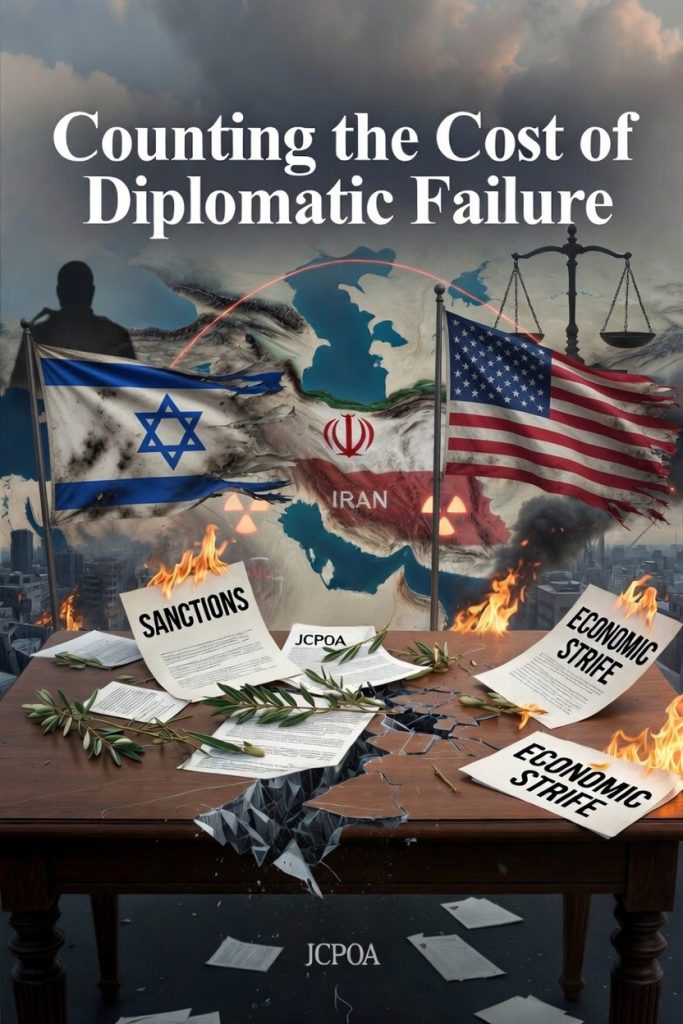
The escalation of tensions between Iran, United States, and Israel in 2025–2026 represents one of the clearest contemporary examples of the costs of diplomatic breakdown. What began as long-standing disagreements over nuclear capabilities, regional influence, and security guarantees has transformed into a full-scale confrontation involving direct military strikes, proxy engagements, and widespread humanitarian consequences. This conflict highlights not only geopolitical rivalry but also the erosion of international norms governing the use of force and protection of civilians. Through the lens of international relations and International Humanitarian Law (IHL), this article examines how failed diplomacy has intensified violence, undermined legal frameworks, and produced severe human and systemic costs.
The conflict in the Middle East illustrates, with unusual clarity, the consequences of sustained diplomatic breakdown. Longstanding disputes gradually intensified after the weakening of the Joint Comprehensive Plan of Action, an agreement that had previously constrained Iran’s nuclear programme in exchange for sanctions relief. When negotiations to revive or replace this framework stalled, mistrust deepened and the strategic environment shifted from managed rivalry to open confrontation. This transition reflects a well-established concept in international relations theory known as the security dilemma, where defensive actions by one state are interpreted as offensive threats by another, thereby triggering escalation. In this context, the absence of effective diplomacy did not simply fail to prevent conflict; it actively created the conditions for its outbreak.
As tensions escalated, the resort to force raised immediate legal concerns under international law. The United Nations Charter explicitly restricts the use of force to cases of self-defense against an imminent armed attack or when authorized by the Security Council. However, analysts have questioned whether military actions taken by the United States and Israel against Iran meet this threshold. The legality of the dual attack on Iran remains a debate, but the applicable framework is well established: Article 51 of the UN Charter sets a high bar for lawful self-defense, and preventive or preemptive strikes remain highly contested in international law. Consequently, when states bypass diplomatic channels and rely instead on unilateral force, they risk undermining the legal order that governs interstate relations.
At the same time, the conduct of hostilities has raised serious concerns under International Humanitarian Law, which regulates how war is fought regardless of its legality. Central to IHL are the principles of distinction, proportionality, and precaution. Distinction requires parties to differentiate between civilians and combatants, while proportionality prohibits attacks that would cause excessive civilian harm relative to anticipated military advantage. Precaution obliges all feasible measures to minimize harm to civilians and civilian infrastructure. Reports from multiple international observers indicate that civilian areas and critical infrastructure—including energy facilities and public services—have been affected during the conflict.When such targets are struck without clear military necessity or with disproportionate effects, these actions constitute violations of customary international humanitarian law and, potentially, war crimes.
The humanitarian consequences of this breakdown in diplomacy have been both immediate and far-reaching. Armed conflict between technologically advanced militaries, combined with the involvement of proxy actors, has resulted in civilian casualties, displacement, and widespread destruction of infrastructure. Disruption of electricity, water systems, and healthcare services has compounded human suffering, particularly among vulnerable populations. According to widely accepted humanitarian assessments, damage to essential civilian infrastructure has cascading effects, including increased mortality from preventable diseases and long-term economic decline. Furthermore, displacement—whether internal or cross-border—places additional strain on already fragile regional systems.
In addition, the conflict has generated broader regional and global implications, demonstrating how diplomatic failure in one arena can destabilize the wider international system. The strategic significance of the Strait of Hormuz, through which a substantial proportion of the world’s oil supply passes, has elevated the stakes considerably. Disruptions to maritime security in this corridor have historically led to fluctuations in global energy prices and heightened economic uncertainty. The involvement of allied and proxy forces across the Middle East has further increased the risk of escalation beyond the original parties, transforming a bilateral or trilateral dispute into a multi-actor regional crisis. From a theoretical standpoint, this reflects the failure of collective security mechanisms, particularly within the United Nations system, where geopolitical divisions often prevent decisive action by the Security Council.
Moreover, the normalization of force as a primary tool of statecraft carries significant long-term risks. When states increasingly justify military action based on perceived rather than imminent threats, the threshold for war is effectively lowered. This shift erodes deterrence stability, as other actors may adopt similar doctrines, leading to a more volatile and unpredictable international environment. At the same time, repeated violations, or perceived violations, of international law weaken its authority. Legal norms rely not only on formal rules but also on consistent adherence by states, especially powerful ones. When these norms are disregarded, enforcement becomes selective, and the credibility of the entire system is called into question.
Equally important is the erosion of trust that accompanies diplomatic failure. International agreements depend on verification mechanisms, mutual confidence, and sustained engagement. Once these elements break down, rebuilding them becomes significantly more difficult. In the case of Iran, the collapse of nuclear negotiations has not eliminated concerns about proliferation; instead, it has intensified them, while simultaneously reducing transparency and cooperation. This creates a paradox in which the use of force, intended to enhance security, may ultimately increase insecurity by removing the very frameworks designed to manage risk.
In conclusion, the ongoing confrontation between Iran, the United States, and Israel underscores the indispensable role of diplomacy in maintaining international peace and security. The breakdown of negotiations has contributed to the unlawful or contested use of force, strained the application of International Humanitarian Law, and produced severe humanitarian consequences. It has also revealed the limitations of existing global governance mechanisms in preventing and managing conflict. Ultimately, the lesson is clear: diplomacy is not merely a preference but a necessity in an interconnected world where the costs of failure are measured not only in geopolitical terms but also in human lives and the erosion of the international legal order.