
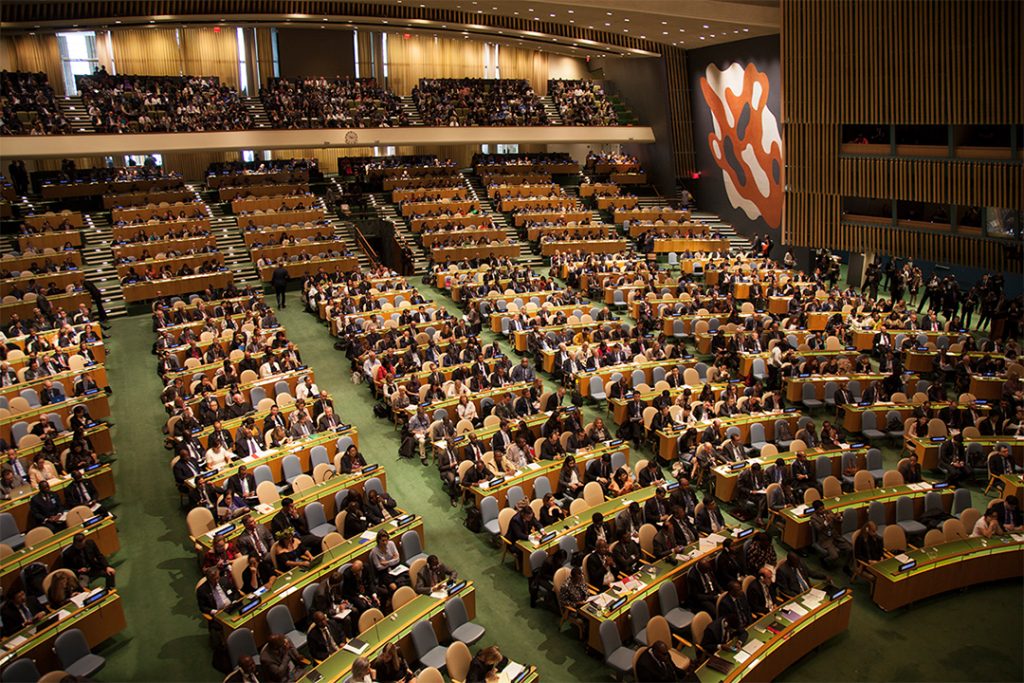
The 80th session of the United Nations General Assembly (UNGA 80) has been more than just a ceremonial milestone. Marking eight decades since the UN’s founding, it offered world leaders a chance to pause, reflect, and reimagine the role of multilateralism in today’s fractured and rapidly changing global order. The theme of the gathering, “Better together: 80 years and more for peace, development and human rights,” signaled both hope and urgency. Yet the debates this year highlighted just how contested the future of the UN has become, as governments confronted questions about institutional reform, geopolitical rivalries, financing shortfalls, and an ever-expanding global agenda. What stood out most were not only the issues under discussion but also the deeper tensions they revealed about the state of international cooperation itself. This article gives an overview of the main debates at the just concluded UN General Assembly.
One of the most striking debates revolved around reforming the UN itself. The Secretary-General’s “UN80 Initiative” has generated significant discussion because of its ambitious goal to modernize the institution and make it more agile. Over the years, the UN has accumulated thousands of mandates, many outdated or overlapping, and calls have grown louder for systematic reviews, sunset clauses, and consolidation. The proposal to deploy new technologies, including artificial intelligence, to identify inefficiencies has been met with interest, but also with skepticism. Ideas on the table include merging agencies with overlapping mandates, trimming bureaucracy, and relocating parts of the organization’s operations closer to regional hubs rather than keeping power concentrated in New York and Geneva. Yet while some member states see these changes as long overdue, others, especially from the Global South, fear that reforms may strip away resources for technical cooperation and development support. What was meant to be a conversation about revitalization turned into a battle over whose priorities will be safeguarded and whose will be scaled back.
Closely connected to the reform debate is a broader crisis of trust in multilateralism. Many delegations acknowledged that the UN’s legitimacy and effectiveness are under severe strain, particularly as powerful states block resolutions or act unilaterally in conflict situations. The paralysis of the Security Council in responding to ongoing crises in Ukraine, Gaza, and Myanmar has underscored a structural weakness at the very heart of the organization. In addition, the UN faces a mounting financial crisis. Unpaid contributions run into billions of dollars, with the United States alone owing around $1.5 billion to the regular budget. Across the UN system, resources fall by nearly 30 percent compared to just two years ago, threatening peacekeeping operations, humanitarian programs, and human rights monitoring. Without stable and predictable funding, reforms risk becoming cosmetic, and critical operations may be put to a halt. For some states, this makes reform an economic necessity; for others, it is seen as a political strategy by powerful donors to assert greater control.
The debates also reflected the broader geopolitical fragmentation of today’s world. Multilateralism itself is being pulled in different directions as rival powers—China, the United States, Russia, and blocs like the European Union—project competing visions of global order. The result is often a patchwork of overlapping alliances and institutions that dilute the authority of the UN. Smaller and middle powers, especially those from Africa, Latin America, and Asia, have used the 80th session to push harder for more equitable representation and a stronger voice in shaping rules on trade, finance, climate, and security. Calls for reform of the Security Council, a long recurring theme, were once again heard loudly. Many argue that without expansion and democratization of its membership, the Council will remain an anachronism, unable to reflect the realities of the mid-21st century. Yet as in past years, entrenched resistance from the current permanent members continues to block progress.
Beyond institutional debates, UNGA 80 also served as a crucial platform for discussing the most pressing global challenges, foremost among them climate change and the Sustainable Development Goals (SDGs). With 2030 fast approaching, there is a palpable sense that time is running out to deliver on the SDG agenda. The “SDG Moment” convened at this year’s session was intended to reinvigorate commitments and mobilize new pledges, following last year’s Pact for the Future which laid out 56 concrete actions for accelerating progress. Climate Change, as expected, dominated the agenda. A dedicated Climate Summit challenged member states to present updated national climate plans, but by the start of the assembly fewer than a third had submitted them. This gap has reignited debates about accountability and fairness in climate action, with developing countries insisting on clearer commitments to adaptation financing, loss and damage compensation, and technology transfers.
The session also drew attention to emerging issues that will increasingly shape global governance. Artificial intelligence featured prominently, with the launch of a Global Dialogue on AI Governance aimed at ensuring that rapid technological advances are managed in an inclusive and rights-respecting way. Health was another focus, with governments negotiating a political declaration on noncommunicable diseases and mental health, recognizing that progress on reducing premature deaths remains far off track. Gender equality and youth participation also stood out, especially as the session marked 30 years since the landmark Beijing conference on women. Leaders spoke passionately about bridging persistent gaps in gender rights and ensuring meaningful youth inclusion in shaping the future of the multilateral system. While these issues energized debates, they also raised concerns about agenda overload. With climate, SDGs, peace, AI, health, gender, and more competing for limited attention and resources, the risk of fragmentation is real.
Conflict and security remained unavoidable points of contention. Leaders repeatedly returned to the ongoing wars and humanitarian crises that have tested the limits of UN diplomacy. From Ukraine to Gaza, speeches reflected both condemnation and frustration at the inability of the UN to enforce peace or even maintain consensus on basic humanitarian measures. At the same time, the session featured renewed appeals for nuclear disarmament and arms control, though geopolitical rivalries continue to block meaningful progress. Here, the tension between sovereignty and collective security was palpable, many states demanded stronger interventionist tools to prevent atrocities, while others warned against undermining national independence under the guise of global responsibility.
What ultimately stood out at the UN’s 80th session was not a single issue but a pattern. Reform is universally acknowledged as necessary, but consensus quickly fractures over the details. The financial crisis is the most immediate and tangible threat, casting doubt on whether the global institution can deliver even on its existing mandates. Geopolitical rivalries are hardening, making collective decision-making ever more elusive. And the global agenda is expanding so rapidly that it risks outpacing the institution’s capacity to respond. Yet despite these tensions, the session also revealed a stubborn optimism that in a world of turbulence, the UN remains the only forum where nearly every state can gather, deliberate, and attempt to forge common ground. The 80th anniversary may not have produced sweeping breakthroughs, but it has forced a reckoning: the UN must evolve or risk irrelevance. Whether member states will summon the political will and financial commitment to drive that evolution remains the defining question as the organization enters its ninth decade.
By Patricia Namakula